Exercises for Diction and Voice: A Daily Practice Plan

You finish a long work call or sing a few favorite songs at karaoke, and your voice already sounds tired. Your throat feels uncomfortable, the root of your tongue becomes rigid, and your words start to blur.
It is easy to blame weak vocal folds or a lack of natural talent. In practice, we often try to create more volume by tightening the neck while the breath remains poorly coordinated and the jaw stays locked. Trying to produce a free, resonant sound from a tense body is like pressing the accelerator with the parking brake on.
The practical exercises for diction and voice below form a complete 15–20 minute daily practice plan. They can help you speak more clearly, use your voice with greater ease, and make everyday practice simple and consistent.
1. Articulation and Diction: Release Unnecessary Tension
Clear speech and free singing begin with mobility. If the neck, lower jaw, or root of the tongue is tense, the sound has less room to move naturally.
Release the Neck and Jaw
- Loose-neck check. While speaking a phrase or singing gently, move your head slightly from side to side as if saying a relaxed “no.” Your neck should stay soft and mobile. If the movement becomes difficult, reduce the volume and release the effort.
- Shoulder release. Take a calm breath and lift your shoulders toward your ears. Exhale through your mouth with a relaxed “Haa” and let the shoulders drop. Repeat three or four times.
- Relaxed jaw drill. Allow the lower jaw to drop slightly down and back, leaving about one and a half to two fingers of space between your teeth. Do not push the chin forward. Read a short paragraph or practice a tongue twister in this position. As an optional variation, hold a clean wine cork very lightly between the front teeth without biting down or forcing the mouth open.
Release the Root of the Tongue
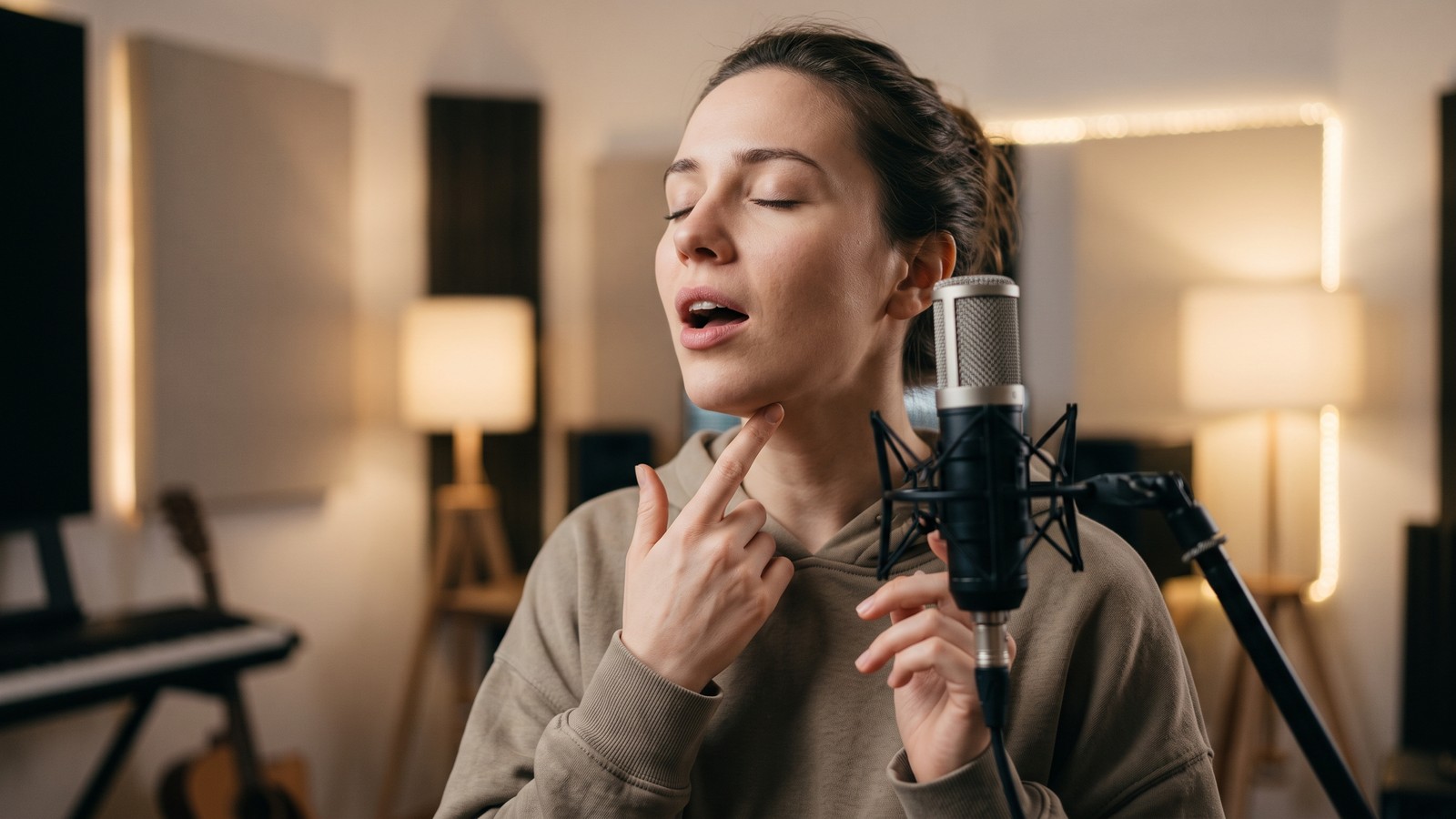
- Thumb check. Place the pad of your thumb against the soft area underneath your chin and sustain an easy “mmm” or “nnn.” The area should remain relatively soft. Strong outward pressure may suggest unnecessary tongue tension, but this exercise is not a medical assessment.
- Quick syllable drill. Repeat “gla-kee-ra, gla-kee-ra” or “gla-kleh, gla-kleh” quickly and rhythmically while keeping the jaw loose. The goal is active but easy tongue movement.
- Tongue-out phonation. Rest the tip of your relaxed tongue on your lower lip and sustain a gentle sound somewhere between “eh” and “ah.” Stay at a comfortable pitch and avoid pressing the sound.
Improve Consonant Clarity
Over-articulation drill. Choose a short poem, song lyric, or paragraph and read it while deliberately exaggerating every movement of your lips and jaw. Shape each consonant as if someone were lip-reading you through thick glass. After two minutes, return to your normal speaking voice. Your words will often feel clearer with less effort.
2. Breath Support and Vocal Focus
Once the articulators feel freer, add breath coordination and gentle semi-occluded vocal tract exercises, often called SOVT exercises. They can help you explore steady airflow and more efficient voicing without unnecessary pressure.
- Controlled “sss” exhale. Take a quiet breath and allow the lower ribs to expand without lifting the shoulders. Release a thin, steady stream of air on “sss” for 15–30 seconds. Do not chase a record; consistency and comfort matter more than duration.
- Fricative sound pulses. Practice short, springy combinations such as “vvv-fff,” “zzz,” and “zh-zh” at a moderate volume. Keep the throat relaxed and aim for a clean, easy sound onset.
- Lip trill. Blow air through relaxed lips to create a gentle “brrr.” Add your voice and glide through a comfortable part of your range from low to high and back down. If the lips do not vibrate easily, support your cheeks lightly with your fingertips near the corners of your mouth.
- Twang siren. Use a bright, slightly nasal “nya-nya-nya” and glide smoothly from a comfortable low note to a higher note. The brightness should appear without shouting or squeezing the throat.
- Short three- to five-note scales. Sing simple patterns on “ee” or “oo” at a light volume, around three out of ten. Stay within a comfortable range and aim for an even tone.
3. A 15–20 Minute Daily Voice Practice Plan
To make daily practice easier, divide your warm-up into short, focused blocks and move through them in order.
| Practice block | Time | Exercises | Goal |
|---|---|---|---|
| 1. Tension release | 3 min | Shoulder drop with “Haa,” gentle head movement, relaxed yawn | More mobility in the neck, shoulders, and laryngeal area |
| 2. Articulation and tongue | 4 min | Thumb check, “gla-kee-ra,” tongue resting on the lower lip | A freer tongue root and more mobile jaw |
| 3. Breath support | 4 min | 15–30 second “sss,” pulses on “zh” and “vvv-fff” | Steadier airflow and an easier sound onset |
| 4. Range warm-up | 5 min | Lip trill, “nya” siren, short scales | A gentle warm-up and clearer vocal focus |
| 5. Diction in context | 4 min | A tongue twister, paragraph, or song with exaggerated articulation | Transfer clarity into real speech and singing |
4. Three Rules for Practicing on Your Own
- Never practice through pain. Stop if you experience pain, persistent scratchiness or irritation, repeated coughing, or worsening hoarseness. Reduce your vocal load. If the symptoms continue, consult an ENT physician or a qualified voice clinician.
- Consistency matters more than duration. Fifteen calm, focused minutes every day will usually be more useful than one exhausting two-hour session each week.
- Record yourself. The voice you hear inside your head differs from a recording because of bone conduction. A short phone recording gives you a more objective sense of whether your diction is clearer and your voice feels freer.
Voice exercises should feel like coordination work, not a fight with your own voice. If the effort increases, pause and return to a quieter, more comfortable version.
5. Ready to Build a Stronger, Freer Voice?
Self-guided exercises are a strong foundation, but personal feedback can help you notice individual tension and choose the most effective exercises for your voice much faster.
At Music Lab, we teach singing and speech technique from the ground up through:
- individual online lessons available worldwide;
- in-studio lessons with personal guidance;
- a modern, supportive method without forcing or unnecessary strain.
During your trial lesson, we will listen to how you currently use your voice, explore your comfortable range, discuss your goals, and outline a clear plan for your development.
Book your free trial lesson and take the first step toward clearer speech, easier singing, and a voice that truly feels like your own.
Trial lesson
Want to understand what your voice can do?
Book a diagnostic trial lesson with a teacher: we’ll listen to your voice, highlight your next steps, and suggest a clear plan. It costs nothing and doesn’t commit you to anything.
No payment, no pressure
Related materials
Why Your Voice Shakes When Singing: Physiology and How to Stop It
When a singer sustains a long note and the sound begins to vibrate or break involuntarily, audio-analysis software may detect abnormal jitt…


How to learn to sing from scratch: a simple guide for future vocalists
Any adult can learn to sing, regardless of age or starting level. The voice is not a closed club for the chosen few, but a physiological in…

How to speak with a loud, strong voice: a guide for future speakers
A practical guide to speaking loudly without shouting: breath support, bright resonance, jaw freedom, and safe exercises for speakers.

Vocal Distortion Lessons: How to Learn Extreme Vocals Without Damaging Your Voice
Vocal distortion adds fire, density, and a signature rasp to the sound. But safe extreme vocals are not built on shouting — they require a …

Fun diction warm-up
A fun diction warm-up: a short exercise for clearer articulation and warming up the speech apparatus.
Complete Vocal Technique (CVT): A Modern Science-Based Approach to Voice
Traditional vocal training still contains many vague metaphors: “send the sound into the dome,” “sing on a smile,” or “feel a column of air…