Rhythm for Vocalists: A Beginner's Foundation
Rhythm is the skeleton of every song — even the most beautiful voice falls apart if it doesn't sit on the beat. This material walks beginner singers and musicians through the core idea of pulse, simple practice exercises, and a fun groove drill you can do anywhere.
By the end you'll be able to clap to a metronome, subdivide beats with your voice, use vocal percussion syllables to feel the groove from the inside, and follow body-percussion drills to lock in timing without an instrument.

Why rhythm matters more than pitch
Most beginner singers obsess over hitting the right notes — but listeners forgive a slightly flat note far easier than a singer who drags or rushes the beat. Rhythm is what makes a performance feel locked in.
Three concepts you must internalize:
- Pulse — the steady invisible heartbeat of the song. A metronome makes it audible.
- Beat — one click of the pulse. In 4/4 time there are four beats per bar.
- Subdivision — the smaller pieces inside one beat (eighth notes, sixteenths, triplets).
If you can clap a steady pulse, count out the beats, and feel the subdivisions inside them, you already have 70% of what professional musicians use every day.
Cup-stacking rhythm exercise
Four simple drills for daily practice
Set a metronome to 70 BPM. Don't speed up until each drill feels effortless.
- Clap on every beat. Just 1-2-3-4. Feel the click and your hands hit at exactly the same instant.
- Count out loud while clapping. Say "one, two, three, four" — your voice and hands locked together. This builds the link between mouth and pulse.
- Clap on 2 and 4. The metronome is on 1 and 3 — you fill the missing beats. This is the backbeat that drives almost every pop song.
- Subdivide with "and". Count "one and two and three and four and". Each "and" is exactly halfway between beats. You just split the bar into eighth notes.
Five minutes a day for two weeks and your timing will already feel different. Promise.
Body percussion: simple rhythm drills
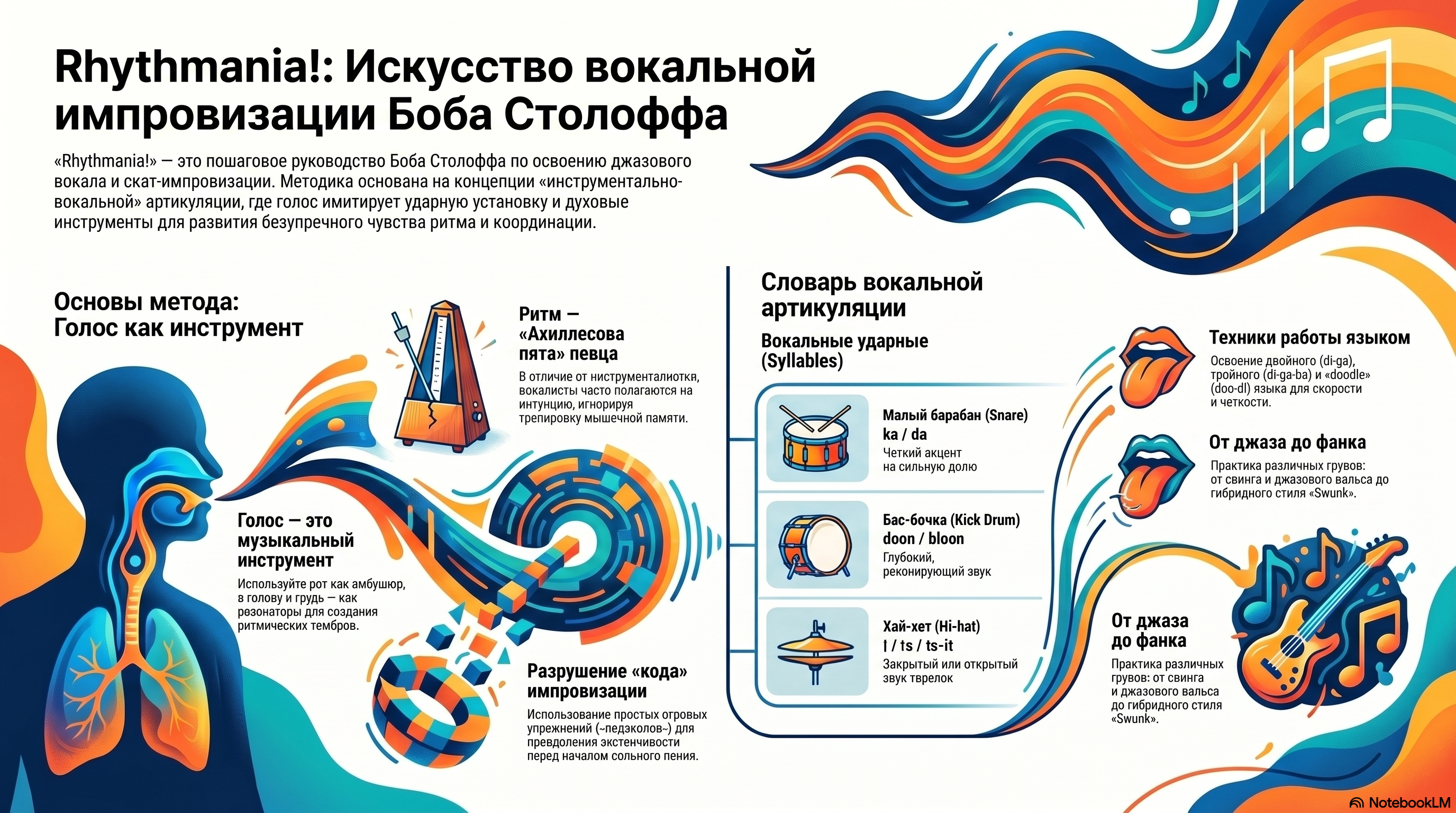
Drill: legato with "double tongue" syllables
This is a foundational vocal-percussion drill that teaches you to feel groove from the inside. You imitate a drum kit with your mouth and connect the strong beats with smooth filler syllables.
The syllables
- doon — a deep kick-drum hit (beat 1, beat 3).
- ka or da — a sharp snare hit (beat 2, beat 4).
- di-ga — connecting syllables that fill the space between strong beats.
How to do it
Speak this pattern over a steady pulse:
doon — di-ga — ka — di-ga
or:
doon — di-ga — da — di-ga
The di-ga fills the pulsation between the main hits, so the groove never feels empty. Start at 60 BPM, lock the kick on beat 1, the snare on beat 3, and let the fillers carry you to the next strong beat.
Bob Stoloff — Rhythmania! (vocal rhythm architecture)
More rhythm exercises — practice along
Quick check
Question 1: What does the metronome give you?
- A. The melody
- B. The pulse
- C. The lyrics
Show answer
B — the pulse. The metronome only marks the beat; melody and lyrics are your job.Question 2: In a 4/4 bar, where does the backbeat fall?
- A. On 1 and 3
- B. On 2 and 4
- C. On every "and"
Show answer
B — beats 2 and 4. That's why drummers hit the snare there.Question 3: In the doon / ka / di-ga drill, which syllable represents the kick drum?
- A. ka
- B. di-ga
- C. doon
Show answer
C — doon. Deep, low, on the strong beats.Trial lesson
Want to understand what your voice can do?
Book a diagnostic trial lesson with a teacher: we’ll listen to your voice, highlight your next steps, and suggest a clear plan. It costs nothing and doesn’t commit you to anything.
No payment, no pressure
Related materials
Why Your Voice Shakes When Singing: Physiology and How to Stop It
When a singer sustains a long note and the sound begins to vibrate or break involuntarily, audio-analysis software may detect abnormal jitt…


How to learn to sing from scratch: a simple guide for future vocalists
Any adult can learn to sing, regardless of age or starting level. The voice is not a closed club for the chosen few, but a physiological in…

How to speak with a loud, strong voice: a guide for future speakers
A practical guide to speaking loudly without shouting: breath support, bright resonance, jaw freedom, and safe exercises for speakers.

How to Sing Like Michael Jackson: Vocal Secrets of the King of Pop
Michael Jackson was not just a famous name; he became a whole phenomenon in popular music. His voice is recognizable from the first instant…
Vocal Support and Breathing: Stop Throat Tension and Sing Freely
Everyone who begins singing eventually hears the phrase “sing with support.” But what does that mean in practice, and how can you develop b…
How to Learn Jazz Singing Remotely: Online Vocal Guide for Beginners
A beginner-friendly guide to learning jazz vocals online: technique, rhythm, scat, microphone work, and practice with legendary standards.